
Growing Children, Text Neck,
and The Importance of Chiropractic Care
Orthopaedics literally means “straight children.” The specialty of orthopedics began in 1741 when French physician, Nicolas Andry de Bois-Regard (1658–1742) published the foundational book Orthopédie (translated as The Art of Correcting and Preventing Deformities in Children) (1, 2). Dr. Andry established that children who were “bent” (not straight) had difficult lives, and that their situation could be improved while still growing.
In this “Crooked Tree,” Dr. Andry used the analogy of a growing tree being tied to a stake to straighten it out. Today, this image is known as the “Tree of Andry” and is the global symbol of orthopaedics.
One hundred and twenty years after the publication of Andry’s book (in 1862), two German orthopedic surgeons, working independently, came up with an explanation for why keeping growing children straight is critically important.
Carl Hueter (1838–1882), German orthopedist, died young; history records that he died of morbid obesity.
Richard von Volkmann (1830–1887) was a surgeon of extraordinary importance. He was co-founder of the German Society for Surgery (1872).
Their independently derived “law” of growing children is today referred to as the:
Hueter-Volkmann Law
The Hueter-Volkmann Law states that increased mechanical compression on a growingbone’s epiphysis (growth plate) reduces the rate of growth, while reduced compression and/or tension stimulates or accelerates bone growth. Simply applied, during growth, if the spine is chronically bent to the side (scoliosis) or forward (kyphosis), the vertebrae do not develop (grow) appropriately. Once growth stops, the spinal deformities are permanent and a source of chronic pain and disability.
By the 1940s, the Hueter-Volkmann Law was being applied to spinal scoliosis in the medical literature. As an example, in 1949, the Journal of Bone & Joint Surgery published a study titled (3):
The Mechanism of the Structural Changes in Scoliosis
The author, orthopedic surgeon Alvin M. Arkin, MD, from Mount Sinai Hospital and Bellevue Hospital, New York City, stated:
“The vertebral deformation of structural scoliosis can be explained by an asymmetrical disturbance of epiphyseal growth by pressure.”
In 1956, Dr. Arkin and colleague Dr. Jacob Katz published another article in the Journal of Bone & Joint Surgery, titled (4):
The Effects of Pressure on Epiphyseal Growth:
The Mechanism of Plasticity of Growing Bone
The authors, Drs. Arkin and Katz, stated:
“When a growing epiphysis is subjected to a stress, the rate or direction of the growth of that epiphysis or both are modified so as to yield to that stress.”
“Pressures applied in directions parallel to the direction of epiphyseal growth inhibit the rate of such growth.”
“While considerable pressures are necessary to stop cartilaginous growth completely, slight or even intermittent pressures can slow or hinder it.”
“The gravitational pressures of normal weight-bearing seem to slow cartilaginous growth in vertical weight-bearing bones.”
•••••••••
Cell phone use is of particular importance to the chiropractic profession because cell phone use causes postural distortions. These postural distortions can have devastating effects on spinal joints, primarily the joints of the low neck (cervical spine) and upper back (thoracic spine), accelerating degenerative spinal joint disease or spondylosis (5, 6, 7, 8). These problems are particularly concerning for growing children because of the potential for life-long debilitation and symptoms as a consequence of the Hueter-Volkmann Law.
This presentation reviews the musculoskeletal problems that are caused by prolonged use of cell phones, and especially as related to the effects on children. Today, these musculoskeletal problems are referred to as “text neck.” “The term ‘text neck’ was first used by chiropractor Dr. Dean L. Fischman” in 2008 (9, 19).
In addition, the prolonged postures associated with cell phone use are being linked to other health problems (10), including:
- Muscle fatigue and myofascial pain syndromes (muscle pain problems and headache) (11, 12, 13).
- Chronic muscle contraction that often results in headaches (14, 15).
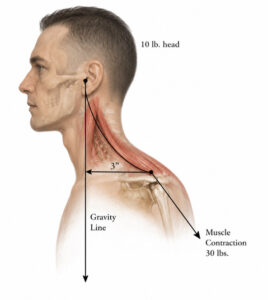
An important concept in the understanding of text neck is the difference between weightversus load. Load is a weight multiplied by a lever arm. Bending the head/neck forward pitches the weight of the head forward of the spine, and the lever arm distance multiplies the stress on the spinal joints, soft tissues, and counterbalancing muscles (16).
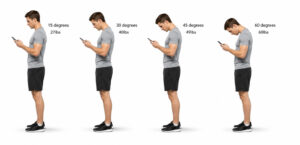
This concept of weight versus load applied to text neck is nicely illustrated in these references (17, 18, 19, 20):
(#17, Cailliet, 1996):
Recent Lay Articles
In 2017, Reuters Health published a study titled (21):
Leaning Forward During Phone Use May Cause ‘Text Neck’
This article makes these points:
- Spine surgeons are noticing an increase in patients with neck and upper back pain, likely related to poor posture during prolonged smartphone use.
- Young patients who should not have back and neck issues are reporting disc hernias and spinal alignment problems.
- In an x-ray, the neck curve typically is being reversed as people look down at their phones for hours each day.
- Prolonged abnormal stresses on a growing spinal column may lead to abnormal spinal development with dire long-term spinal health consequences in adulthood.
- Simple lifestyle changes are suggested to relieve the stress from the “text neck” posture, including holding cell phones in front of the face while texting and using two hands and two thumbs to create a more symmetrical and comfortable position for the spine.
- People who work on computers or on tablets should use an elevated monitor stand that sits at a natural horizontal eye level.
- Take frequent rest breaks and/or engage in some physical exercise that can strengthen the neck and shoulder muscles.
•••••••••
In 2018, The New York Post published a study titled (22):
Tech is Turning Millennials into a Generation of Hunchbacks
This article profiles the situation of a young man who began suffering from upper-back pain and neck soreness while in his late teens, after a habit of hunching over his cellular phone. As his symptoms progressed, he developed constant pain, he hunched his shoulders, and the pain caused him to wake up numerous times throughout every night.
After a decade of suffering, the patient’s chiropractor diagnosed him with “tech neck,” explaining that the cause was the forward/bent neck posture he assumed while using his laptop and iPhone. The loss or reversal of the normal cervical curve is easily diagnosed with postural x-rays.
Treatment options included chiropractic, restorative postural traction, and postural and core exercises.
Medical Literature Studies
In 2014, a study was published in the journal Surgical Technology International, titled (18):
Assessment of Stresses in the Cervical Spine
Caused by Posture and Position of the Head
The purpose of this study was to assess the forces incrementally seen by the neck (cervical spine) as the head is tilted forward, worsening forward head posture; the results are illustrated above. The author notes:
“Poor posture invariably occurs with the head in a tilted forward position and the shoulders drooping forward in a rounded position.”
“The weight seen by the spine dramatically increases when flexing the head forward at varying degrees.”
“Loss of the natural curve of the cervical spine leads to incrementally increased stresses about the cervical spine. These stresses may lead to early wear, tear, degeneration, and possibly surgeries.”
•••••••••
In 2017, a study was published in the journal Applied Ergonomics, titled (23):
Texting on Mobile Phones and Musculoskeletal Disorders in Young Adults
The aim of this study was to examine whether texting on a mobile phone is a risk factor for musculoskeletal disorders in the neck and upper extremities in a population of young adults, aged 20-24 years. The study duration was 5 years. The authors concluded:
“Sitting with the head bent forward while texting was more common among those with musculoskeletal symptoms.”
“Associations were found between text messaging and reported pain in the neck/upper back, shoulder/upper extremities, and numbness/tingling in the hand/fingers for both men and women.”
“There were clear associations between the highest category of text messaging and pain in the neck/upper back.”
“Sustained neck flexion may be a risk factor for developing pain in the neck, shoulder, and upper extremities.”
“Sitting with the head bent forward without supporting the arms causes a static load in the neck and shoulder muscles, which could explain the reported pain from neck/upper back.”
“Sustained muscle load and posture are considered to be risk factors for developing musculoskeletal disorders.”
•••••••••
Also in 2017, a study was published in The Spine Journal, titled (24):
“Text Neck”
An Epidemic of the Modern Era of Cell Phones?
The authors note that extensive cell phone use and associated postures cause spondylotic changes consistent with an aged spine, but they are now being found in younger age groups. These authors propose that there are significant increases in intradiscal pressure during flexion, and that “chronic increased intradiscal pressure likely contributes to disk degeneration [cervical spondylosis] and herniation.” The authors note:
“It now seems rather clear that repetitive texting, or similar activity while using a forward flexed neck position, may lead to neck pain or ‘text neck.’”
These authors have great concern for the consequences of prolonged cervical spine flexion while texting on the developing (growing) spine. They make these recommendations to avoid and/or treat text/tech neck:
- Patients hold their cell phone up at or near eye level while texting.
- “For patients who spend significant time working at a computer or tablet we recommend the use of elevated stands for desktop monitors so that the monitor is at a natural horizontal gaze level.”
- Subjects should perform basic exercises that stretch and strengthen the cervical and upper thoracic soft tissue.
•••••••••
In 2021, a study was published in the International Journal of Environmental Research and Public Health, titled (25):
Text Neck Syndrome in Children and Adolescents
The authors present a case report of a 16-year-old female presenting with headache, dizziness, neck pain, vertigo, and ataxia. MRI (Magnetic Resonance Imaging) of the cervical spine showed a reversal of cervical lordosis and posterior disc protrusion at the C4–C5 level. The doctor’s working diagnosis was “text neck syndrome.”
The authors note that the improper use of personal computers and cell phones might be related to the development of a complex cluster of clinical symptoms commonly defined as “text neck syndrome.” Children and adolescents spend 5 to 7 hours a day on their smartphones and handheld devices with their heads flexed forward to read and text. The cumulative effects of this exposure cause an alarming excess stress to the cervical spinal structures. The authors state:
“[The] text neck syndrome has increased stresses on the cervical spine, which can lead to cervical degeneration along with other developmental, medical, psychological, and social complications.”
“This clinical condition refers to the onset of cervical spinal degeneration that results from the repeated stress of frequent forward head flexion while we look down at the screens of mobile devices and while we text for long periods of time.”
“The weight of the head on the spine is dramatically increased when it is flexed forward, and the effects and amount of weight are strongly and progressively enhanced by varying the degrees.”
The authors make these “text neck” preventative recommendations:
- Avoid excessive neck flexion.
- Avoid excessive device usage and take frequent breaks.
- Position the device so that it reduces stress both on the head and neck.
- Limit the time of use of smartphones, tablets, and PCs.
•••••••••
In 2023, a study was published in the journal Cureus, titled (26):
Pediatric Text Neck Syndrome
The authors note:
“The increasing prevalence of social media, mobile texting, video streaming, and gaming due to the widespread adoption of smartphones has led to emerging health concerns, including the overuse condition known as text neck syndrome.”
“Text neck syndrome is a growing concern in the pediatric population due to the increased use of mobile devices and screens, potentially leading to long-lasting musculoskeletal issues.”
“Prolonged exposure to poor postural habits in children may result in long lasting musculoskeletal issues and a higher risk of spine-related disorders later in life.”
“As mobile device usage continues to increase, the pediatric population is becoming particularly vulnerable to the development of kyphotic deformities in the growing and premature spinal structure.”
“Chiropractors are educated to recognize structural or movement abnormalities that could cause injury or discomfort if left untreated.”
“[Manual therapy has] demonstrated clinical benefits in correcting reversed cervical curvature.”
The authors present a case of a six-year-old boy with a history of headache, cephalgia, and cervicalgia. His symptoms coincided with prolonged usage of a mobile device (more than eight hours per day). The child’s pediatrician prescribed non-steroidal anti-inflammatory drugs, muscle relaxants, and a regimen of stretching and exercise, all without any benefit. Subsequently, the patient sought chiropractic care.
Chiropractic manipulation was used to re-establish postural stability and correct spinal alignment. Cervical extension-traction was used to reestablish normal cervical curvature. By the end of the third month, the patient reported a complete resolution of symptoms.
Educational efforts were used to promote proper smartphone usage. Regular exercise and core strengthening programs were encouraged to promote healthy spines and mitigate the potential adverse effects of excessive smartphone use on pediatric spinal health.
•••••••••
In 2025, a study was published in the Journal of Clinical Medicine, titled (19):
Physiotherapy in Text Neck Syndrome:
A Scoping Review of Current Evidence and Future Directions
This study reviewed 15 papers that focused on various methods used in text neck rehabilitation, including postural correction exercises, stabilization exercises, strengthening and stretching exercises, and manual therapy. The authors note:
“Musculoskeletal disorders associated with excessive smartphone use represent a significant health issue.”
“Prolonged screen time on smartphones may lead to numerous adverse health consequences.”
“Such behavior may adversely impact human health, leading to adverse consequences, such as musculoskeletal strain and the onset of neck and cervical pain.”
“The prevalence of musculoskeletal disorders among smartphone users ranges from 50% to 84%, particularly affecting areas such as the neck, shoulders, upper back, and upper body.”
“Prolonged strain on the neck can lead to excessive muscle tension, changes in the natural curvature of the cervical spine (e.g., flattening of cervical lordosis), pain and discomfort, and, in the long run, possible damage to spinal structures.”
“Excessive smartphone use can be particularly harmful to children.”
“[It is] estimated that the prevalence of neck pain in groups aged 7–11 years who are spending around 5–8 hours daily using electronic devices is around 70%.”
“Children aged 2–5 years should not spend more than one hour per day using a mobile phone, while children and adolescents aged 5–17 years should limit their usage to 2 h per day during leisure time.”
Their discussion on treatment of text next syndrome includes these comments:
“Manual therapy is used to increase the range of motion, restore proper joint mechanics, normalize the tension of paraspinal tissues, and reduce pain during movement.”
“Manual therapy not only addresses the cervical spine but also works on the thoracic spine and the cervicothoracic junction.”
“Manual therapy may include manipulations and mobilizations.”
“The effectiveness of manual therapy has also been demonstrated in individual case reports of people with text neck syndrome.”
“The best treatment outcomes are achieved through a combination of strengthening and stretching exercises, manual therapy, and postural correction.”
••••••••••
Chiropractors are expertly trained in the ergonomic avoidance of the postures that lead to text neck. Chiropractic clinical practice offers a variety of treatment approaches, including joint adjusting, that are very effective in the management of text neck syndrome (27, 28, 29, 30, 31, 32, 33, 34, 35, 36).
REFERENCES:
- Biedermann H; Manual Therapy in Children; Churchill Livingston; 2004.
- Kohler R; Nicolas Andry de Bois-Regard (Lyon 1658–Paris 1742): The Inventor of the Word ‘‘orthopedics’’ and the Father of Parasitology; Journal of Children’s Orthopedics; August 4, 2010; Vol. 4; No. 4; pp. 349-355.
- Arkin AM; The Mechanism of the Structural Changes in Scoliosis; Journal of Bone & Joint Surgery; July 1949; Vol. 31; No. 3; pp. 519-528.
- Arkin AM, Katz JF; The Effects of Pressure on Epiphyseal Growth: The Mechanism of Plasticity of Growing Bone; Journal of Bone & Joint Surgery; October 1956; Vol. 38; No. 5; pp. 1056-1076.
- Garstang SV, Stitik SP; Osteoarthritis; Epidemiology, Risk Factors, and Pathophysiology; American Journal of Physical Medicine and Rehabilitation; November 2006; Vol. 85; No. 11; pp. S2-S11.
- Ruch W; Atlas of Common Subluxations of the Human Spine and Pelvis, Second Edition; Life West Press; 2014.
- Uchida K, Nakajima H, Sato R, Yayama T, Mwaka ES, Kobayashi S, Baba H; Cervical Spondylotic Myelopathy Associated with Kyphosis or Sagittal Sigmoid Alignment: Outcome after Anterior or Posterior Decompression; Journal of Neurosurgery: Spine; November 2009; Vol. 11; pp. 521-528.
- Grosso M, Hwang R, Mroz T, Benzel, Steinmetz M; Relationship between degree of focal kyphosis correction and neurological outcomes for patients undergoing cervical deformity correction surgery; Journal of Neurosurgery: Spine; June 18, 2013; Vol. 18; No. 6; pp. 537-544.
- “The term ‘text neck’ was first used by chiropractor Dr. Dean Fischman,” in 2008. (19)
- Davis D; Disconnect: The Truth About Cell Phone Radiation; 2013.
- Travell J, Simons D; Myofascial pain and dysfunction, the trigger point manual; New York; Williams & Wilkins; 1983.
- Travell J, Simons D; Myofascial pain and dysfunction, the trigger point manual: THE LOWER EXTREMITIES; New York; Williams & Wilkins; 1992.
- Simons D, Travell J; Travell & Simons’, Myofascial pain and dysfunction, the trigger point manual: Volume 1, Upper Half of Body; Baltimore; Williams & Wilkins; 1999.
- Seletz E; Headache of Extracranial Origin; California Medicine; November 1958; Vol. 89; No. 5; pp. 314-317.
- Bogduk N; Anatomy and Physiology of Headache; Biomedicine and Pharmacotherapy; 1995; Vol. 49; No. 10; pp. 435-445.
- Bowman K; Move Your DNA: Restore Your Health Through Natural Movement; 2017.
- Cailliet R; Soft Tissue Pain and Disability; 3rd Edition; FA Davis Company; 1996.
- Hansraj KK; Assessment of Stresses in the Cervical Spine Caused by Posture and Position of the Head; Surgical Technology International; November 2014; Vol. 25; pp. 277-279.
- Piruta J, Ku?ak W; Physiotherapy in Text Neck Syndrome: A Scoping Review of Current Evidence and Future Directions; Journal of Clinical Medicine; February 19, 2025; Vol. 14; No. 4; Article 1386.
- Dunlop K; The Neck: A Natural and Cultural History; 2025.
- Crist C; Leaning forward during phone use may cause ‘text neck’; Reuters Health; April 14, 2017.
- Fleming K; Tech is Turning Millennials into a Generation of Hunchbacks; The New York Post; March 5, 2018.
- Gustafsson E, Thoee S, Grimby-Ekman A, Hagberg M; Texting on Mobile Phones and Musculoskeletal Disorders in Young Adults: A Five-year Cohort Study; Applied Ergonomics; January 2017; Vol. 58; pp. 208-214.
- Cuéllar JM, Lanman TH; “Text Neck” An Epidemic of the Modern Era of Cell Phones?; The Spine Journal; June 2017; Vol. 17; No. 6; pp. 901–902.
- David D, Giannini C, Chiarelli F, Mohn A; Text Neck Syndrome in Children and Adolescents; International Journal of Environmental Research and Public Health; February 7, 2021; Vol. 18; No. 4.
- Chu EYT, Mok TKS, Ng GSN, Chu E; Pediatric Text Neck Syndrome; Cureus; April 23, 2023; Vol. 15; No. 4; Article e38034.
- Leach RA; An evaluation of the effect of chiropractic manipulative therapy on hypolordosis of the cervical spine; Journal of Manipulative and Physiological Therapeutics; March 1983; Vol. 66; No. 1; pp. 17-23.
- Harrison DD, Jackson BL, Troyanovich S, Robertson G, de George D, Barker WF; The efficacy of cervical extension-compression traction combined with diversified manipulation and drop table adjustments in the rehabilitation of cervical lordosis: a pilot study; Journal of Manipulative and Physiological Therapeutics; September 1994; Vol. 17; No. 7; pp. 454-64.
- Troyanovich SJ, Harrison DE, Harrison DD. Structural rehabilitation of the spine and posture: rationale for treatment beyond the resolution of symptoms; Journal of Manipulative and Physiological Therapeutics; January 1998; Vol. 21; No. 1; pp. 37-50.
- Harrison DE, Harrison, DD, Haas JW; CBP Structural Rehabilitation of the Cervical Spine; 2002.
- Harrison DE, Cailliet R, Harrison DD, Janik TJ, Holland B; A new 3-point bending traction method for restoring cervical lordosis and cervical manipulation: a nonrandomized clinical controlled trial; Archives of Physical Medicine and Rehabilitation; April 2002; Vol. 83; No. 4; pp. 447-w53.
- Morningstar MW, Strauchman MN, Weeks DA; Spinal manipulation and anterior headweighting for the correction of forward head posture and cervical hypolordosis: A pilot study; Journal of Chiropractic Medicine; Spring 2003; Vol. 2; No. 2; pp. 51-54.
- Harrison DE, Harrison DD, Betz JJ, Janik TJ, Holland B, Colloca CJ, Haas JW; Increasing the cervical lordosis with chiropractic biophysics seated combined extension-compression and transverse load cervical traction with cervical manipulation: nonrandomized clinical control trial; Journal of Manipulative and Physiological Therapeutics; March-April 2003; Vol. 26; No. 3; pp. 139-151.
- Ferrantelli JR, Harrison DE, Harrison DD, Stewart D; Conservative treatment of a patient with previously unresponsive whiplash-associated disorders using clinical biomechanics of posture rehabilitation methods; Journal of Manipulative and Physiological Therapeutics; March- April 2005; Vol. 28; No. 3; pp. e1-8.
- Oakley PA, Harrison DD, Harrison DE, Haas JW; Evidence-based protocol for structural rehabilitation of the spine and posture: review of clinical biomechanics of posture (CBP) publications. Journal of the Canadian Chiropractic Association; 2000.
- Chu EC; Preventing the Progression of Text Neck in a Young Man: A Case Report; Radiology Case Reports; January 18, 2022; Vol. 17; No. 3; pp. 978-982.
“Authored by Dan Murphy, D.C. Published by ChiroTrust® – This publication is not meant to offer treatment advice or protocols. Cited material is not necessarily the opinion of the author or publisher.”
